Emergency readiness is often defined by speed, clarity and access to the right supplies at precisely the right moment. When an unexpected case arises, the ability to replenish or assemble emergency kits rapidly is not a convenience—it is a core operational safeguard. Modern practices, clinics, centres and organisations increasingly rely on streamlined procurement platforms, real-time inventory visibility and consolidated supplier access to ensure that essential items are always ready for immediate use. Rapid ordering has become an integral part of emergency preparedness, supporting not only stock availability but also continuity, team coordination and supply-chain resilience.
Well-prepared emergency kits rely on more than good intentions. They depend on structured stock planning, low-inventory alerts, consumable tracking, demand forecasting and reliable procurement workflows. When these elements work together, teams are poised to respond confidently during unplanned events, without the delays traditionally caused by fragmented ordering processes, supplier bottlenecks or manual stock checks.
What Key Elements Should an Effective Emergency Kit Ordering System Include?
A dependable emergency-kit replenishment process generally incorporates several core operational features:
- Centralised ordering from multiple suppliers
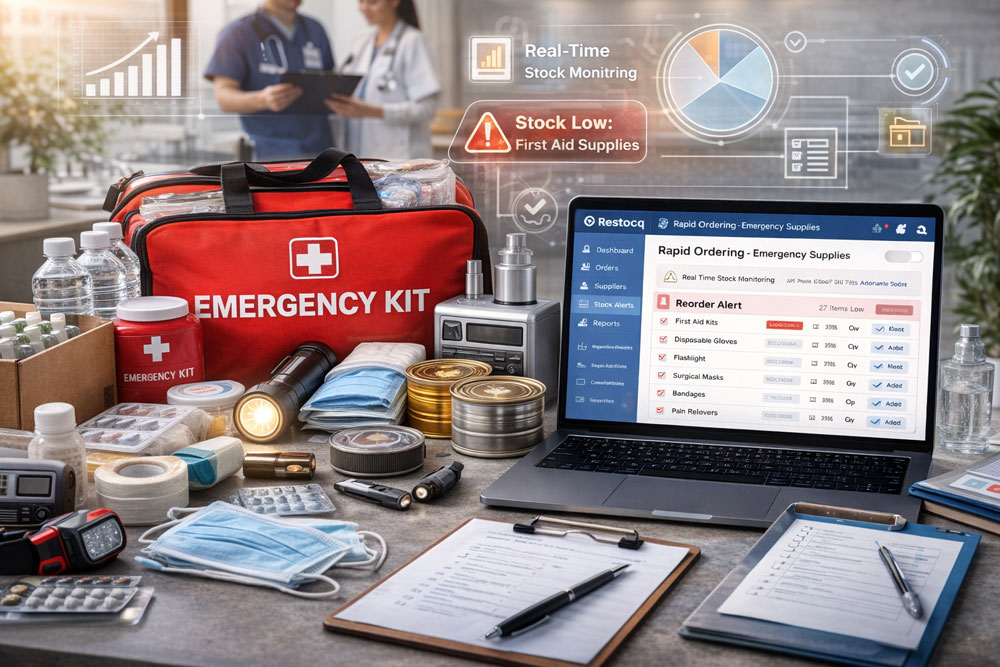
- Real-time stock monitoring and alerts
- Usage-based replenishment
- Quick-access order lists
- Spend visibility and inventory tracking
- Team-based workflow with approvals
- Delivery and order-status transparency
These components ensure that emergency supplies—whether consumables, disposables, instruments or ancillary materials—remain consistently ready for immediate deployment.
Why Does Centralised Ordering Improve Emergency Preparedness?
Centralised platforms allow organisations to order from multiple suppliers in one streamlined system. Instead of logging into separate accounts, managing various catalogues or juggling supplier relationships, teams can access all required consumables from a single hub.
Key benefits of a centralised model:
- Reduced administrative time
- Elimination of multi-supplier complexity
- Greater accuracy when restocking specific kit components
- Standardisation across multiple team members or locations
Centralisation also supports better visibility of delivery status, supplier lead times and product availability—factors that become critical when restocking emergency kits under time pressure.
How Does Inventory Visibility Prevent Emergency Stockouts?
Emergency kits are only effective when every component is available at all times. Stockouts often occur due to:
- Lack of real-time inventory monitoring
- Manual stock checks
- Delays in reordering consumables
- Low-stock thresholds not being predefined
- Inconsistent ordering responsibilities within the team
A clear inventory system with automated triggers ensures practices remain fully equipped.
Example Table: Key Inventory Controls That Support Emergency Kit Readiness
| Inventory Control Function | Purpose in Emergency Readiness |
| Real-time stock monitoring | Prevents unintentional depletion of critical items |
| Low-stock alerts | Signals when emergency components are nearing minimum safe levels |
| Usage-based forecasting | Predicts consumption patterns and prepares for unexpected spikes |
| Quick-reorder lists | Enables rapid replenishment of essential consumables |
| Multi-user visibility | Ensures team members have unified access to stock information |
What Role Does Rapid Ordering Play During Unexpected Cases?
Unexpected cases often arise without warning, leaving no time for delayed procurement or disorganised workflows. Rapid ordering systems support emergency response by allowing:
- Immediate access to essential consumables
- Fast submission of supplier orders
- Reliable restocking through pre-defined, favourite or template lists
- Speedy internal approvals
- Transparent order tracking from placement to arrival
Rapid ordering also supports supply-chain resilience by ensuring organisations can adapt quickly to fluctuations in usage or unplanned demands.
How Can Teams Maintain Consistency When Preparing Emergency Kits?
Consistency is vital when multiple team members coordinate emergency supplies. Structured workflows help ensure the right items are ordered in the right quantities every time.
Effective team structures may include:
- Dedicated roles for ordering and approval
- Standardised kit lists with specific item codes
- Restricted permissions to prevent unauthorised changes
- Team-wide visibility of historical orders
- Shared insights on high-usage materials
With these measures, emergency kits remain uniform, predictable and compliant with internal operational standards.
What Procurement Challenges Commonly Affect Emergency Preparedness?
Several issues commonly impact emergency-kit readiness:
- Fragmented supplier ordering portals
- Human error during manual stock checks
- Delays caused by relying on a single team member
- Unpredictable lead times or stock shortages
- Lack of consumption tracking
- Missing purchase records or delivery histories
These challenges can be mitigated through automation, predictive stock alerts, consolidated ordering and workflow controls.
How Can Restocq Strengthen Emergency Kit Readiness for Organisations?
Before progressing to references, it is important to highlight a solution designed specifically to address the challenges discussed above. Restocq offers a centralised ordering platform that unifies multiple suppliers, simplifies consumable purchasing and provides real-time insights into stock levels, usage patterns and team workflows. By consolidating procurement into one clear system, Restocq helps organisations maintain reliable emergency kits through rapid ordering, low-stock alerts, intelligent replenishment tools and complete visibility across teams and locations.
For organisations seeking to strengthen emergency responsiveness, improve procurement speed and reduce the risk of stockouts, Restocq delivers an efficient and intuitive solution designed to support operational continuity during unexpected situations.
Research & References
- Australian Government – Department of Health and Aged Care: Guidelines on emergency preparedness and consumables management
- Australian Institute for Disaster Resilience – Resource collection on preparedness frameworks
- Therapeutic Goods Administration – Supply chain and device availability considerations
- Safe Work Australia – Guidance on workplace readiness and safety supplies
FAQs
1. What types of supplies should be included in an emergency kit?
Emergency kits typically contain consumables, basic instruments, protective equipment and essential items required for stabilising or managing unexpected cases. Selection depends on the operational environment and internal protocols.
2. How often should emergency kits be reviewed?
Regular reviews are recommended, with many organisations adopting monthly checks supported by automated low-stock alerts and usage-based monitoring systems.
3. What makes rapid ordering essential for emergency preparedness?
Rapid ordering ensures that depleted items can be replenished immediately, minimising downtime and maintaining continuity during unforeseen events.
4. How do predictive reorder tools support emergency readiness?
Predictive tools evaluate historical consumption patterns to forecast future needs, helping teams pre-empt supply shortages before they impact emergency response.
5. Can multiple team members participate in emergency kit ordering?
Yes. Multi-user systems allow different staff members to reorder, approve and track items while maintaining accuracy and oversight.
6. How does centralised supplier access reduce delays?
By consolidating procurement into a single system, organisations eliminate the inefficiencies of navigating multiple supplier platforms, resulting in faster ordering and improved stock consistency.